
Boat houses
These buildings recall the importance of whaling boats and crews in harbour life.
ATLANTIC · MARINE WILDLIFE · LIVING HERITAGE
Out in the Atlantic, meeting the ocean’s giants takes patience, curiosity and respect.
Whale and dolphin watching in the Azores is not a staged performance. It is a journey offshore into a deep, changing ocean, where visitors learn to read the signs, listen to experienced guides and accept that wild animals choose their own course. The experience has another distinctive layer: the vigias that once spotted sperm whales for the whaling crews are now part of an island heritage connected to a different relationship with the sea.
AN OCEAN FULL OF LIFE
Set in the North Atlantic, the Azores sit among wide oceanic spaces shaped by deep water, underwater slopes and changing currents. These habitats are used by resident, visiting and migratory cetaceans. Different inventories describe different ranges. The Important Marine Mammal Area factsheet lists 19 species regularly sighted in the region and notes other species documented less frequently. It is useful to distinguish the species recorded in Azorean waters from those visitors may actually see on a trip.
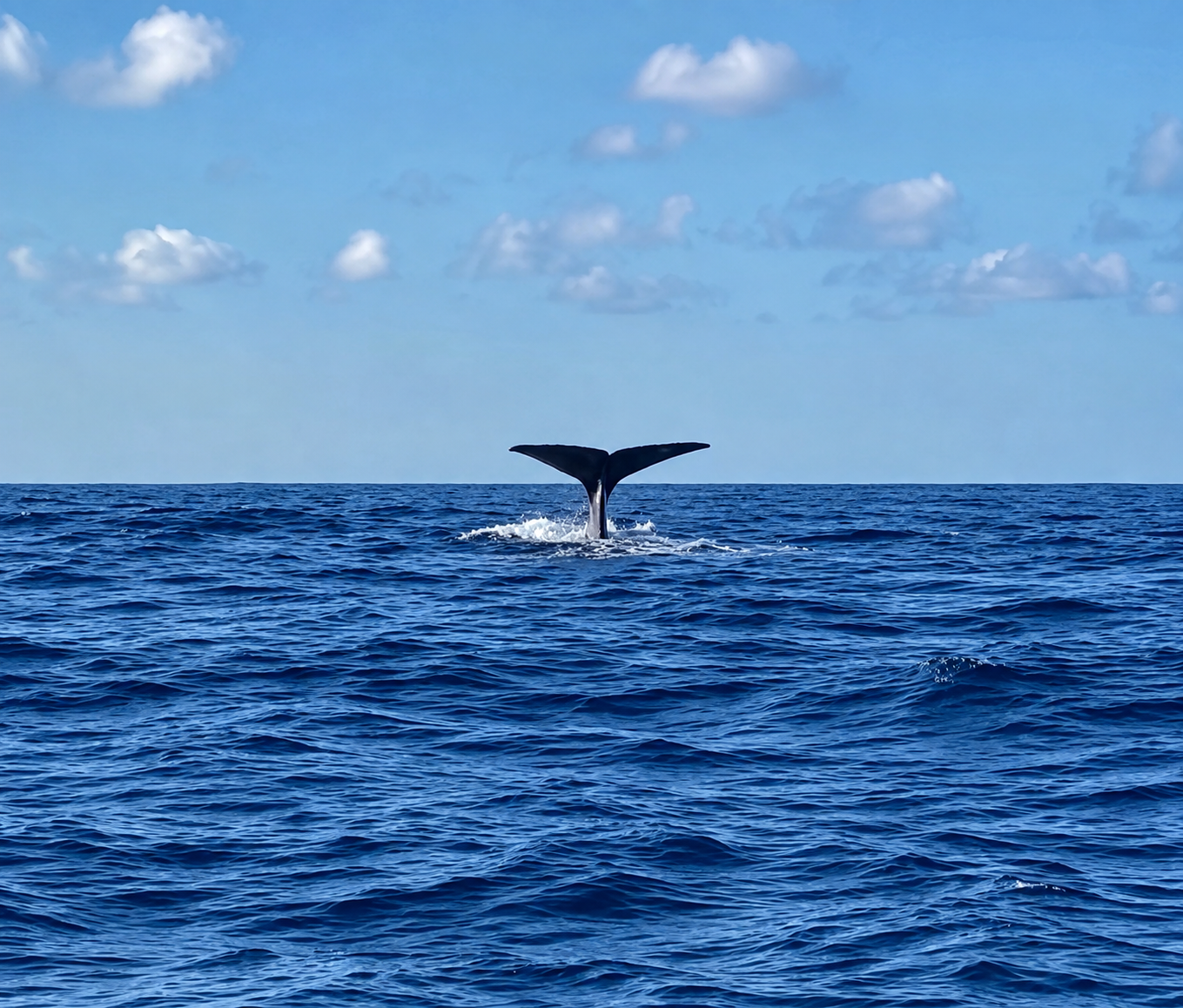
Sperm whales are among the best-known inhabitants of Azorean waters. Common dolphins and bottlenose dolphins may be encountered throughout the year, while migratory species such as blue and fin whales are more seasonal. The archipelago also provides important feeding habitat for several large cetaceans. At sea, a guide may recognise a blow, a fin or a dive sequence long before passengers can make out the animal. Learning to notice these details is part of what makes the trip rewarding.
HISTORY · FROM THE LOOKOUT TO THE SEA
From the nineteenth century onwards, sperm whaling became an important part of the maritime economy on several islands. Pico grew into one of the main centres, although whaling was practised across the archipelago. On headlands and high ground, lookouts watched the horizon from small buildings or purpose-built stations known as vigias. Their task was to spot a whale’s blow, estimate its direction and alert the crews. On shore, boat houses, launching ramps, workshops, factories and harbours formed a working landscape facing the open sea.
This heritage is not limited to boats and equipment. It includes navigation skills, boatbuilding, tools, sea stories, the dangers of the trade and the economic ties between coastal communities. The Whalers’ Museum in Lajes do Pico preserves part of this history. Other heritage sites and routes help visitors follow the chain of work, from the lookout to the harbour and the shore-based facilities.
Whaling gradually lost its economic importance and ended in the 1980s; 1986 is commonly cited as the year the activity ceased in the archipelago. Whale watching began to develop at the end of that decade, first on Pico and later on São Miguel in the early 1990s. Some local knowledge, lookout posts and the experience of former whalers found a new purpose: locating cetaceans without pursuing them.
This transition does not erase the contradictions of the past. It invites a more honest view of heritage: the objects and memories belong to an industry that shaped island communities, while cetaceans are now understood as wild animals whose presence deserves protection. Museums, workshops, local festivities and the Whaling Route tell this story without reducing it to a neat tale of reinvention.
CULTURE · TRANSMISSION
In the Azores, the whale is also a shared memory, an artistic subject and a way of telling the islands’ story with the Atlantic.
These buildings recall the importance of whaling boats and crews in harbour life.
Engraving on whale teeth or bone is part of the material history of whaling. Today it is best understood as heritage, not as encouragement to trade in cetacean products.
On Pico, Semana dos Baleeiros and related traditions keep the memory of maritime communities alive.
Vigias, ramps and quays form a scattered heritage still visible in the island landscape.
SMALL DETAILS · A CLOSER LOOK
The visible blow is warm, moist air released at the surface. Its shape and direction can help an experienced observer recognise a species or group, although it is not always enough for a certain identification from a boat.
Sperm whales are adapted to finding food at depth. After a series of breaths at the surface, one may disappear underwater for an extended period. Waiting is part of the encounter, not a gap that needs filling.
On some trips, land-based observers still help locate animals and pass information to crews at sea. The coastal landscape and the offshore experience remain connected.
CHOOSING WHEN TO GO
Cetaceans do not all follow the same calendar. Sperm whales, common dolphins and bottlenose dolphins may be seen throughout the year. Migrating large whales are more seasonal, with some species more likely during spring, but their presence depends on many natural factors. A favourable season may improve the chances of an encounter; it is never a promise.
Your departure island matters too. São Miguel, Pico, Faial, Terceira and other islands have specialist operators, each with a different setting and route offshore. If whale watching is a priority, leave room in your itinerary: an extra day can make it easier to reschedule when wind or swell are unsuitable.
RESPONSIBLE WILDLIFE WATCHING
Cetacean watching in the Azores is governed by regional rules first introduced in 1999 and amended over time. They aim to balance tourism with animal protection. Operators must not pursue cetaceans when they repeatedly avoid a boat or show signs of disturbance, split a group or separate a calf from an adult, feed animals, make noise to attract them or pollute the sea. The rules also set limits for approach distances, vessel speed and time spent near the animals.
Choose a licensed operator that explains its approach, respects distances and backs away when animals show signs of disturbance. Follow the crew’s instructions, keep noise down and take all rubbish back to shore. The best encounter is one that allows the animals to continue on their own route.
GETTING READY
Bring clothing suitable for wind and spray, even when the day feels mild on land. A warm layer, waterproof outerwear, stable shoes and sun protection are useful. If you are prone to motion sickness, seek advice from a healthcare professional or pharmacist before departure and tell the operator. Conditions offshore can feel cooler and rougher than they do in the harbour.
Check the exact meeting time and place, the stated duration and the cancellation or rescheduling terms. Families with children, pregnant travellers and visitors with limited mobility should ask in advance whether the boat and the day’s sea conditions are suitable. Keep your camera ready, but do not let the screen distract you from the animals themselves.
MARIA™ · PLAN YOUR TRIP
If whale watching is one of your priorities, Maria™ can help you choose islands, spread your nights and keep some flexibility in your route. Rather than locking the activity to one fixed date, build a trip that leaves more than one opportunity to head out to sea.
For further practical and heritage information, consult these regional resources.

MARIA™
Build a coherent itinerary around the islands, your priorities and the time available.
Plan my trip
MIGUEL™
Once on the islands, compare your wish to go offshore with the conditions and other options available.
Decide with Miguel™